Home Blog

Thomas Müller Left on the Bench as Whitecaps Fall to San Jose

Thomas Müller Vancouver Whitecaps Analyse Taktik Daten Statistik MLS USA Champions Cup Kanada

Mark Zhuang

Müller Back on the Bench in Defeat

Thomas Müller’s week with the Vancouver Whitecaps came to a rather disappointing end.

After sitting on the bench for 76 minutes during last weekend’s dominant 6–0 home win over Minnesota in MLS play, he experienced elimination from the Champions Cup midweek. Even with Müller in the starting lineup, Vancouver were unable to overturn the 0–3 first-leg deficit against Seattle, instead suffering another 1–2 loss.

On Matchday 5, the Whitecaps then recorded their first MLS defeat of the season, falling 0–1 to the San Jose Earthquakes. Müller, along with Timo Werner on the opposing side, started the match on the bench.

Even First Half

The two former German internationals watched a fairly balanced first half, reflected in the numbers: 50–50 possession, 6–7 in shots, and 0.63 to 0.67 in expected goals.

Vancouver had to cope without their key midfield duo, Sebastian Berhalter and Andrés Cubas, and struggled to find solutions against a man-oriented defensive setup.

Ralph Priso repeatedly attempted to break lines with bold vertical passes. However, the central space in front of the penalty area — occupied this time by AZ Jackson in the No. 10 role — was rarely accessed effectively, and he appeared somewhat uncomfortable in that position.

Setback Before Halftime

Despite that, the Whitecaps created several promising situations, mainly through one-on-one duels on the wings and long balls in behind the defensive line. Around the half-hour mark, a lead — particularly through chances for the lively Brian White — would not have been undeserved.

At the same time, San Jose found solutions against Vancouver’s press, often using effective third-man combinations, preventing sustained pressure. Vancouver’s left defensive side once again showed vulnerabilities.

Just as the first half seemed headed for a scoreless draw, San Jose struck. Following a corner, Cheick Sabaly miscontrolled the ball, allowing Beau Leroux to fire a stunning long-range shot into the top corner from around 20 yards.

Possession Without Ideas — Even with Müller

Sørensen reacted at halftime: Müller came on, AZ Jackson shifted back to his natural left-sided role, and Sabaly was taken off.

However, it quickly became apparent that this would not be Müller’s day. His early involvements lacked precision, and his substitution ultimately provided little attacking spark.

Vancouver’s possession rose to 74% in the second half, but it lacked creativity. The result: just five shots, 0.35 expected goals, and no shot involvement from Müller.

San Jose focused entirely on defending their lead after the break. Their winning goal before halftime remained their final shot of the match. Even the introduction of Timo Werner in the 54th minute did not change the dynamic.

Most of Vancouver’s attacks ended on the flanks, with numerous crosses that were ultimately too predictable — although the defeat was also somewhat unlucky given the nature of the goal conceded.

A Mixed Week for Müller

Overall, it was a mixed week for Thomas Müller.

Two appearances off the bench in MLS, including a defeat, combined with elimination from the Champions Cup, defined a challenging stretch.

For the Vancouver Whitecaps, the upcoming international break may come at a good time — although several players will be away with their national teams.

In two weeks, Vancouver return to action at home against the Portland Timbers, whom they defeated 4–1 just recently in their only MLS road match so far this season.

The latest texts:
First Title Already Slipping Away for Thomas Müller? Whitecaps Suffer Heavy Champions Cup Defeat
What Thomas Müller’s Vancouver Whitecaps Still Need to Improve


First Title Already Slipping Away for Thomas Müller? Whitecaps Suffer Heavy Champions Cup Defeat

Thomas Müller Vancouver Whitecaps Analyse Taktik Daten Statistik MLS USA Champions Cup Kanada

Chaehyun Lim

Sørensen Rotates the Lineup

“The first half of the season revolves around the Champions Cup,” Thomas Müller said a few days ago.

However, his head coach Jesper Sørensen may see things slightly differently. His starting lineup for the first leg of the Champions Cup Round of 16 already hinted at that.

Compared to Vancouver’s convincing 4–1 MLS win at the Portland Timbers, Sørensen made several changes to the lineup. Those adjustments ultimately showed both in the performance and on the scoreboard, as the Canadian side suffered a clear 0–3 defeat.

A Disjointed Press

“It was my decision to make several changes to the lineup. Of course that affects the rhythm somewhat,” Sørensen admitted after the loss.

Müller not only started the match but also stayed on the field for the full 90 minutes. Still, from the opening whistle it was noticeable that the lineup — without Brian White, AZ Jackson, Andrés Cubas, and Ralph Priso — lacked cohesion.

Vancouver’s normally sharp pressing looked unusually porous. Large gaps repeatedly opened behind the first pressing line around Müller, and defensive assignments were occasionally unclear.

This allowed Seattle to escape pressure far too easily and quickly transition into attack. At the same time, the Whitecaps won very few high turnovers early on and were therefore unable to establish their usual dominance or control of the match.

Instead, the Sounders repeatedly created dangerous attacking situations. Around the midway point of the first half, a Seattle lead would not have been undeserved.

Possession Without Ideas

Sørensen’s team lined up in their usual 4-2-3-1, with inverted left back Tate Johnson’s positioning determining whether Vancouver built up in a 2-3 or 3-2 structure.

Seattle defended in a compact 4-4-2, successfully closing off the central spaces. As a result, Müller often drifted toward the wings just to get touches on the ball. Even the in-form playmaker Sebastian Berhalter rarely received the ball in dangerous areas.

Consequently, many Vancouver attacks ended on the flanks. Even when the Whitecaps managed to work their way into promising positions, the final pass or finish was often missing.

The 32nd minute offered a glimpse of what can happen when Müller receives the ball centrally in front of the penalty area. With quick awareness, he redirected a pass into space on the left flank — but Kenji Cabrera’s shot was ultimately harmless.

A Setback Before Halftime

Frustratingly for Vancouver, just as they began to stabilize midway through the first half — with improved counter-pressing and increasing territorial control — they conceded shortly before the break.

A poorly weighted back pass from center back Mathías Laborda, not the first of its kind this season, was ruthlessly punished by Seattle.

Despite holding just 41 percent possession, the visitors’ lead was not entirely undeserved given the higher quality of their chances, with both teams recording seven shots by halftime.

Pressing Errors Lead to Goals

In the second half, it was clear that captain Müller tried to take responsibility.

He drifted even more frequently to the wings and occasionally dropped deeper into central areas to get involved. Still, Vancouver struggled to create clear scoring chances.

Seattle, on the other hand, struck again in the 58th minute.

Once more, the goal originated from poorly coordinated pressing. Four Whitecaps players converged on a single opponent, who still managed to escape the pressure. That left large spaces open on the right flank and exposed Vancouver’s high defensive line — allowing Seattle to score with a bit of fortune.

Substitutions Bring Little Change

After halftime, Ralph Priso had already replaced Tristan Blackmon. Later, Sørensen attempted to inject fresh energy by bringing on winger Cheick Sabaly and striker Brian White.

The partnership between Müller and Rayan Elloumi — who had led the line with commitment — seemed to lack chemistry both in and out of possession.

The double substitution, however, failed to spark a turnaround.

Vancouver’s best chance to pull one back came from a corner, while Müller himself attempted a header following a cross. But the decisive ideas against Seattle’s deep defensive block were still missing.

Another Defensive Breakdown

Immediately after that double chance from the corner kick came the next blow.

Once again, a lack of coordination in Vancouver’s pressing left space completely open behind left back Johnson. Similar to the second goal, this led — again with a touch of luck — to Seattle’s third.

Müller Hits the Crossbar

From that point on, the Whitecaps dominated the final third but rarely looked truly dangerous.

With the penultimate action of the match, Müller nearly grabbed an important consolation goal. The ball fell kindly to the 36-year-old inside the box, but his difficult attempt crashed against the crossbar.

A Mountain to Climb

The Vancouver Whitecaps now face a daunting task in the second leg next week in Seattle.

With the Champions Cup’s away-goals rule in effect, Vancouver must overturn a three-goal deficit. After this first leg, the dream of lifting the first trophy of the season already seems distant — even if the 0–3 result slightly exaggerates the gap given the 17–10 shot advantage for the home side.

Müller vs. James Rodríguez Next

Before that, however, MLS action continues on Sunday.

At BC Place, the Whitecaps will host Minnesota United — and Müller could face a familiar name from European football. James Rodríguez, who recently joined Minnesota, may make his debut in the matchup against Vancouver.

The latest texts:
What Thomas Müller’s Vancouver Whitecaps Still Need to Improve
Berhalter’s Magic Foot Delights Thomas Müller

What Thomas Müller’s Vancouver Whitecaps Still Need to Improve
Thomas Müller Vancouver Whitecaps Analyse Taktik Daten Statistik MLS USA Champions Cup Kanada

Chaehyun Lim

A Perfect Start for the Whitecaps

Advancing in the Champions Cup and three wins from the first three MLS matches — the 2026 season could hardly have started better for the Vancouver Whitecaps and Thomas Müller.

Especially when looking at the underlying numbers.

Based on expected goals, Vancouver clearly outperformed their opponents in each league match. The defense has been excellent, never allowing more than 0.43 xG in a single game. Offensively, the Whitecaps lead the league with a total expected goals value of 7.5.

Accordingly, Vancouver also tops the MLS table in expected points so far, with 8.4.

Struggles Against Deep Blocks?

Still, there is room for improvement in attack — admittedly criticism at a very high level.

The Whitecaps have occasionally struggled to create chances from structured possession against deep defensive blocks.

A look at how their ten competitive goals have been scored illustrates the point: five from set pieces, two from counter-pressing situations, and “only” three from open play.

The two matches against Cartaginés in particular showed how difficult it can be against teams that defend extremely deep. That said, those games came at the very start of the season and Vancouver rotated parts of the lineup.

New Solutions Will Be Needed

Don’t get me wrong — I’m deeply impressed by the way Vancouver plays.

Sebastian Berhalter’s set-piece deliveries and the team’s aggressive counter-pressing are genuine weapons.

However, given their dominant style and strong results, the Whitecaps are likely to face opponents defending even deeper in the future as their status as favorites continues to grow. Teams may also attempt to bypass Vancouver’s counter-press by immediately clearing the ball.

To deal with that, Vancouver will need better solutions to access central spaces in front of the opposition’s back line.

So far, Thomas Müller has often had to drift toward the wings to get involved in attacking situations.

Müller as the Key?

And yet Müller himself could be the key to unlocking more creativity in the final third.

With his exceptional spatial awareness and instinct as a classic “Raumdeuter,” he has the ability to create new attacking patterns. Especially considering that the German veteran is still not at his peak form and likely has another gear to find.

Criticism at the Highest Level

Ultimately, this remains criticism at a very high level for the Vancouver Whitecaps.

But Müller is certainly used to those expectations after 16 years at Bayern Munich — and he likely demands the same constant improvement from himself.

Head coach Jesper Sørensen’s words after the recent 4–1 victory over the Portland Timbers underline that Vancouver is on the right track:

“I think it was our strongest performance of the season so far.”


The latest texts:
Berhalter’s Magic Foot Delights Thomas Müller
Thomas Müller & the Vancouver Whitecaps – A Perfect Match?

Berhalter’s Magic Foot Delights Thomas Müller

Thomas Müller Vancouver Whitecaps Analyse Taktik Daten Statistik MLS USA Champions Cup Kanada

Chaehyun Lim

Opposing Coach Points to Müller as an Example

The Vancouver Whitecaps and Thomas Müller continued their impressive run even in their first MLS road match of the young season. After two home wins, the Canadian side defeated the Portland Timbers 4–1, with Müller playing the full 90 minutes.

The Bavarian legend even served as a role model for the opposition, as Portland head coach Phil Neville pointed out after the match:

“I want them all to watch the game again and look at Thomas Müller tracking back in the 90th minute. Some of our guys didn’t do that.”

Neville highlighted the 36-year-old’s intensity and relentless work rate.

Indeed, Müller became increasingly influential as the match progressed. Early on he again drifted toward the left flank to collect touches, but within Vancouver’s familiar 4-2-3-1 the visitors were once again the dominant side in possession, particularly in the first half.

Counter-Pressing Sets the Tone

Against Portland’s often compact 4-3-3 defensive shape, designed to crowd the center, Vancouver had no hesitation playing through pressure into their ball-secure double pivot of Andrés Cubas and Sebastian Berhalter.

In deeper build-up phases, the Whitecaps frequently formed a 2-4 structure, which opened passing lanes to the flanks and allowed them to bypass the Timbers’ press.

Portland, meanwhile, relied on counterattacking opportunities and waited for Vancouver mistakes — which appeared two or three times before halftime, though without consequence.

Why the Whitecaps allowed so few counterattacks despite their heavy possession became clear shortly before the opening goal. After a high turnover, Jeevan Badwal immediately chased the ball down and won it back. The resulting counter-pressing sequence ultimately led to the opener: striker Brian White finishing from close range after a precise cross from Berhalter.

It was the visitors’ first real chance.

Müller Growing into the Game, Berhalter Outstanding

Following the opening goal, Müller increasingly found space in central areas — and his teammates found him.

While not everything came off for the number 13 in possession and a few unnecessary turnovers crept into his game, he once again delivered value without the ball. Constantly coaching teammates, making intelligent runs, and even setting subtle blocks against defenders, Müller created space for others.

One of his two attempts came in the 33rd minute. After helping break Portland’s press with a clever layoff pass, he fired from around 20 yards just seconds later.

Shortly after halftime, another Berhalter set piece effectively sealed the match. His free-kick delivery from the half-space found center-back Tristan Blackmon at the far post, whose second attempt eventually found the net.

At that point the game appeared settled against a largely harmless opponent that had barely created any chances. The outstanding Berhalter then capped a strong move in the 63rd minute, finishing calmly from the edge of the box after excellent work from winger AZ Jackson to make it 3–0.

A Brief Wobble

With more space opening up, the Whitecaps increasingly enjoyed themselves in possession. Müller, in particular, seemed to relish the combinations, delivering several clever passes. His movements were not always conventional — but often effective. The same applied to his defensive work, which repeatedly disrupted Portland’s attempts to regain momentum.

Still, the Timbers briefly found a way back when Eric Izoita scored with a stunning long-range strike in the 72nd minute after a triple substitution from Vancouver.

For a moment the momentum shifted. The Whitecaps dropped deeper and appeared slightly unsettled. Yet with Portland finishing the match on just 0.5 expected goals, the danger never truly materialized. Müller himself helped defend several dangerous deliveries into the box.

A Comfortable Win in the End

Instead, Vancouver quickly regained control and exploited the open spaces once more. In the 87th minute, another aggressive counter-pressing action sparked the final goal. Substitute Kenji Cabrera slipped a through ball to Brian White, who completed his brace to make it 4–1.

In the end, it was a deserved victory for the Whitecaps, reflected in the numbers: 17–7 in shots and 3.1 expected goals.

Müller delivered what could be described as a typical Müller performance — providing significant value to his team even without scoring or assisting.

His leadership qualities were also evident after the third goal, when he signaled to his teammates not to celebrate too wildly in front of the home crowd and even apologized to the Portland supporters.

Vancouver’s MLS record in 2026 remains perfect: three wins and an 8–1 goal difference.

Next up is the first leg of the Champions Cup Round of 16 at home against the Seattle Sounders on Friday morning (German time).

Thomas Müller & the Vancouver Whitecaps – A Perfect Match?

Thomas Müller Vancouver Whitecaps Analyse Taktik Daten Statistik MLS USA Champions Cup Kanada

Chaehyun Lim

After watching the first four competitive matches of the new season in full, it’s easy to understand why Thomas Müller chose the Vancouver Whitecaps after leaving Bayern Munich.

A Clear Playing Identity Built on Control

The Canadian side’s controlled style of play suits the 36-year-old perfectly.

It already starts with goalkeeper Yohei Takaoka, who is heavily involved in the build-up phase. Within a possession-oriented 4-2-3-1 system that emphasizes width and ball control, Müller can operate in his signature role behind the striker — a position he mastered during his 16 years at Bayern.

Head coach Jesper Sørensen gives Müller considerable freedom to move between spaces and rotate positions across the attacking line. The key principle remains simple: as long as the structure of the system stays intact, players are encouraged to roam.

Side note: based on what I’ve seen so far, Sørensen looks like a very capable coach with a clear tactical identity. His team also plays with remarkable intensity out of possession. The aggressive pressing structure fits Müller perfectly, allowing him to act as both initiator and leader of the press.

A Well-Balanced Squad

Beyond Müller, the Whitecaps roster itself is intriguing.

As Müller recently pointed out after the latest victory, Vancouver has built impressive squad depth.

The double pivot is a good example of that balance. Playmaker Sebastian Berhalter — son of former Bundesliga player Gregg Berhalter — complements the more defensive-minded ball-winner Andrés Cubas extremely well.

The wide positions are also versatile. Several players can operate on either flank and shift between wide and inverted roles. A noticeable pattern: one wide player tends to occupy the half-space while the other provides width, creating a structure in possession that often resembles a 3-box-3.

Müller’s Chemistry with the Striker

Perhaps most important for Müller is his connection with the center forward — and that partnership appears to be developing nicely with Brian White.

Their movement seems to complement each other well on the field, particularly in how they coordinate runs in the final third. And judging by recent comments from White, their chemistry extends off the pitch as well.

A Promising Start to the Season

All things considered, the partnership between Thomas Müller and the Vancouver Whitecaps increasingly looks like a perfect match.

That was already visible during the second half of last season, when Vancouver made a run all the way to the MLS Cup Final.

Now, with two wins to open the MLS campaign — including Müller’s brace — and progression in the Champions Cup, the start to the new season has been flawless.

The defense, anchored by Tristan Blackmon and Ralph Priso, has been particularly impressive. Not only has Vancouver kept clean sheets in every match so far, but opponents have rarely managed to create meaningful scoring chances.

Plenty to Look Forward To

With that in mind, it will be fascinating to see what the rest of the season holds for Müller and the Whitecaps.

The first four matches have certainly whetted the appetite — and I’m already looking forward to Vancouver’s next MLS matchup against the Portland Timbers.

If you don’t want to miss any of my analyses of Thomas Müller at the Vancouver Whitecaps, feel free to follow me on X: @ballorientiertc

Thomas Müller Bags a Brace as Whitecaps Cruise Past Toronto in All-Canadian Clash

Thomas Müller Vancouver Whitecaps Analyse Taktik Daten Statistik MLS USA Champions Cup Kanada

Chaehyun Lim

Two Wins from Two

“The machine starts to roll,” Thomas Müller said in a post-game TV interview early Sunday morning (German time).

His Vancouver Whitecaps made it two wins from two to open the MLS season, cruising to a commanding 3–0 home victory over Toronto FC at BC Place in an all-Canadian showdown.

Müller in Full Orchestrator Mode

Müller played a decisive role in a result that carried significant weight for the home crowd.

Operating in his familiar No. 10 role within Vancouver’s 4-2-3-1, he looked to impose himself immediately — initially less through direct attacking output and more through on-field coaching. He was constantly organizing the press and adjusting teammates’ positioning in possession.

His body language in the opening ten minutes suggested some frustration: Vancouver’s buildup felt too deliberate against a Toronto side sitting deep with limited possession. Müller tried to accelerate the tempo with quick one- and two-touch combinations to inject rhythm into the attack.

A Roaming Müller Unlocks Space

After that cautious opening spell, Vancouver began to create real danger. In the 15th minute, Müller nearly opened the scoring, redirecting a scuffed effort from midfielder Sebastian Berhalter just wide of the post.

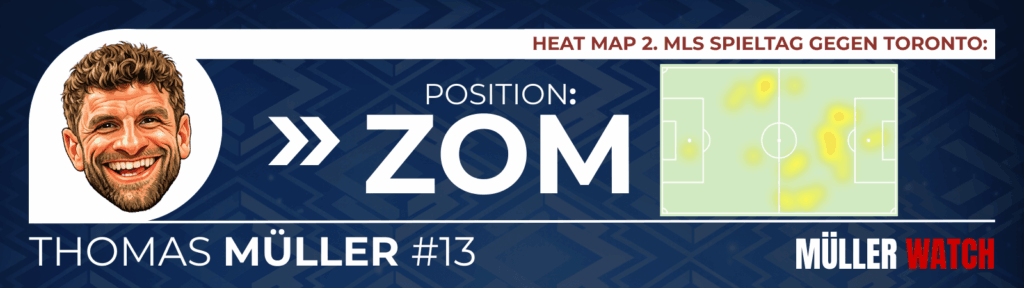
The Whitecaps’ counter-pressing grew increasingly aggressive, pinning Toronto deeper and limiting their ability to escape their own half. Facing a compact low block, Müller frequently rotated positions — first drifting left, later popping up on the right — attempting to destabilize Toronto’s defensive structure.

Three Before the Break

With Müller finding little space centrally between the lines, the breakthrough came in transition.

Striker Brian White flicked on a long ball into the path of winger AZ Jackson, who drove into the box and was brought down. Müller calmly converted the ensuing penalty low to the left, marking his tenth goal in just 17 appearances for Vancouver — and there was more to come.

Both additional goals before halftime stemmed from set pieces delivered by Berhalter.

In the 37th minute, after a headed flick-on from Mathis Laborda, Müller was left unmarked at the back post and finished clinically from close range with his left foot to complete his brace.

Deep into first-half stoppage time, Toronto goalkeeper Luka Gavran misjudged a cross, allowing White to tap home the third and effectively seal the match before halftime.

Game Management After the Break

With a comfortable lead, Vancouver shifted into control mode in the second half.

Possession dropped from 67% to 57%, and the wave of high-quality chances seen in the first half (2.5 expected goals) disappeared. Toronto, meanwhile, generated just 0.24 xG across the entire match.

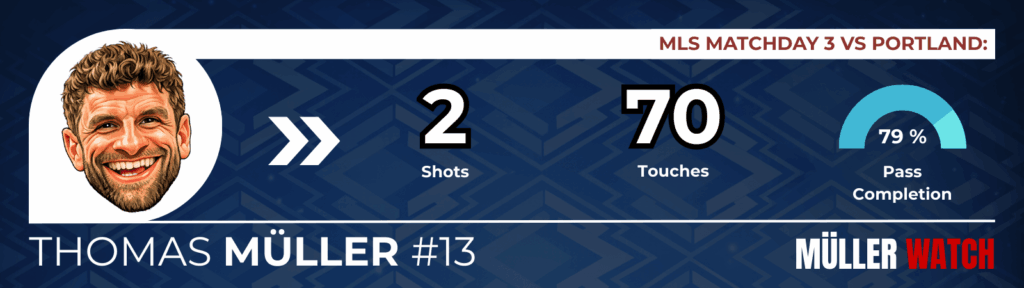
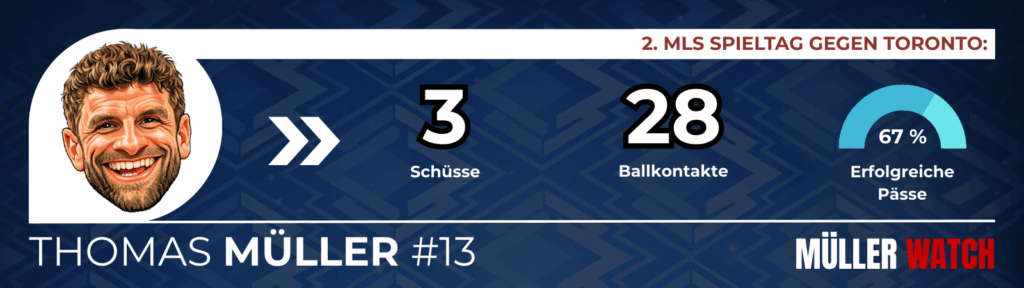
Despite Müller’s two goals and strong leadership presence, there were a few loose touches and turnovers. He finished with a 68% pass completion rate — a number that mattered little given the overall control of the game.

Head coach Jesper Sørensen summed it up succinctly: “He played very well.”

Subbed After 70 Minutes

Müller’s night ended in the 70th minute as Sørensen rotated following an intense stretch of four matches in ten days.

After the game, Müller emphasized how much he values the squad’s depth — essential given Vancouver’s high-intensity approach. Once again, the Whitecaps started aggressively, pressing early to generate quick turnovers and dictate tempo from the outset.

A Statement Start to the Season

While Sørensen noted encouraging tactical patterns — such as repeatedly isolating the pacey AZ Jackson in one-on-one situations through quick switches of play — all three goals ultimately came from set pieces. There remains room for greater creativity in open play in the final third.

Still, with two MLS wins and progression in the Champions Cup, Vancouver and Müller are now four matches unbeaten — and yet to concede a goal.

They’ll have a full training week before traveling to face the Portland Timbers next weekend in their third MLS fixture.

Off the Post for the Third Time: Lively Substitute Thomas Müller Still Searching for First Goal

Thomas Müller Vancouver Whitecaps Analyse Taktik Daten Statistik MLS USA Champions Cup Kanada

Chaehyun Lim

Müller on the Bench as White Misses Early Chances

Compared to their successful MLS opener last weekend, Vancouver Whitecaps head coach Jesper Sørensen made several changes to the starting XI for the Champions Cup second leg at home against CS Cartaginés. As in the 0–0 first leg in Costa Rica, Thomas Müller began the match on the bench.

Without their captain, the favored Canadian side controlled the first half but failed to convert that dominance into a lead. For the third competitive match in a row, Vancouver went into halftime scoreless.

Striker Brian White had the best opportunities. After a highly questionable handball decision, the 30-year-old American saw his penalty saved by the visiting goalkeeper. Earlier, he had already squandered a close-range chance.

Müller Raises the Tempo

Müller entered at halftime, stepping into his familiar No. 10 role with the task of injecting creativity into Vancouver’s rather methodical possession play against another deep-lying defensive block.

The impact was immediate.

Less than two minutes after coming on, one of his trademark one-touch layoffs, followed by a penetrating half-space run and cross, created Vancouver’s first real spark of the second half.

Operating as a connective presence in the half-spaces — much like in the MLS opener against Real Salt Lake — Müller increased the tempo through quick combinations and two-touch passing sequences. He consistently kept the ball moving at speed. Even off the ball, he influenced the match with intelligent runs and constant communication.

Just six minutes after entering the game, he nearly broke the deadlock, directing a headed effort from a cross in the right channel onto the post.

Breakthrough After Sustained Pressure

It felt inevitable.

In the 58th minute, during a lively spell following Müller’s introduction — by then he had already registered three attempts — Vancouver finally took the lead. A Sebastian Berhalter corner was recycled and fell to left winger Kenji Cabrera, who finished from close range with a well-struck half-volley to make it 1–0.

Cartaginés offered little response. Aside from a dangerous free-kick delivery, the visitors struggled to create meaningful pressure. Their only second-half shot in the 66th minute came from an offside position. With just 35% possession, they repeatedly lost the ball against Vancouver’s aggressive high press.

Agonizingly Close Again

Still, Müller’s first goal of the young season would have to wait.

In the 77th minute, after initiating a move from a throw-in, he drove diagonally from the left half-space toward the center and unleashed a precise right-footed effort from just outside the box — only to hit the right post for the third time this season.

Teammate Berhalter had better fortune three minutes later, reacting quickest to a rebound inside the area to make it 2–0 and effectively seal the tie.

Encouraging Early Form

Despite the continued finishing frustration, Müller’s early-season form looks promising.

His halftime introduction decisively shifted the flow of the match. By executing seemingly simple concepts — quick release, immediate movement, clean combinations — at a high level, he helped Vancouver play with greater clarity and intensity.

In the Round of 16 of the Champions Cup, the Whitecaps will now face MLS rivals Seattle Sounders.

This weekend, Vancouver returns to league play against fellow Canadians Toronto FC at BC Place. With advancement in the Champions Cup, a season-opening MLS win over Real Salt Lake, and still no goals conceded across all competitions, the Whitecaps have made an impressive start to 2026.

Sharp Thomas Müller Denied by the Post in MLS Season Opener

Thomas Müller Vancouver Whitecaps Analyse Taktik Daten Statistik MLS USA Champions Cup Kanada

Mark Zhuang

Müller Keeps His Word

“We’re going to win. I hope I’ll be smiling in three hours,” Thomas Müller said with his trademark charm in a pregame TV interview ahead of Vancouver’s MLS opener on Sunday morning.

He kept that promise.

The Whitecaps edged Real Salt Lake 1–0 at BC Place, with Müller playing the full 90 minutes in the season opener.

Constant Movement in the No. 10 Role

Unlike his substitute appearance in midweek Champions Cup action, Müller started brightly from kickoff.

Operating in his customary No. 10 role within a 4-2-3-1, the German was highly active — particularly in horizontal movement. He drifted into both half-spaces, combining with dynamic wingers AZ Jackson and Emmanuel Sabbi.

At times, striker Brian White dropped deeper alongside Müller, effectively transforming Vancouver’s shape into a 4-2-2-2 in possession, with the wingers occupying the highest positions.

Inches Away from a Goal

After just over 16 minutes, Müller came agonizingly close to opening his league account.

A loose sequence fell kindly to him about 18 yards out. With one clean touch onto his left foot, he drove a low effort toward the bottom-right corner — only for the post to deny what would have been his tenth goal in 15 appearances for Vancouver.

In the 33rd minute, Müller — drifting wide left — delivered a precise cross after a quick one-two, but midfielder Sebastian Berhalter sent his effort over the bar. Those would remain Müller’s only two direct shot involvements on opening day.

Jackson Strikes Behind Müller

Despite enjoying 58% possession and appearing technically superior, the Whitecaps struggled to create high-quality chances against a well-organized Real Salt Lake defense.

The breakthrough came in the 57th minute.

A deflected cross from left back Tate Johnson found AZ Jackson in the left channel, and the offseason signing finished clinically from around 12 yards — just behind Müller’s positioning — for the decisive 1–0.

Controlled Finish

From there, Vancouver managed the match professionally.

After surviving a few nervy moments in the first half — including a narrowly disallowed RSL goal for offside — the Whitecaps allowed virtually no significant chances after the break.

In a hectic closing stretch, a tactical switch to a back five helped secure the clean sheet.

Pressing as the Foundation

While Müller was less involved in possession during the second half, his influence remained evident.

Throughout the match, the captain organized the press, identified pressing triggers, and maintained a high work rate. His intensity helped Vancouver regain possession early and control large stretches of the game.

However, as in the Champions Cup fixture earlier in the week, creativity in the final third remains a work in progress. Müller was not consistently found between the lines, and much of Vancouver’s attacking threat came through individual wing play.

A Solid Platform to Build On

The numbers underline a deserved — if not spectacular — victory: 13–10 in shots and 1.5 to 1.1 in expected goals.

Head coach Jesper Sørensen, who recently extended his contract, described it as a solid start.

For Müller personally, it was an encouraging foundation:

47 touches
82% pass completion
and inches away from his first goal of the season.

Next up is Thursday’s Champions Cup second leg at home against CS Cartaginés after a 0–0 draw in the first leg. Through two competitive matches, Vancouver remains unbeaten and has yet to concede.

Now the focus shifts to developing more consistent solutions in the final third — with Müller at the center of that evolution.

Scoreless as a Substitute: Thomas Müller Opens the Season in Costa Rica

Thomas Müller Vancouver Whitecaps Analyse Taktik Daten Statistik MLS USA Champions Cup Kanada
Foto: Diego Obando

Müller Comes Off the Bench Against Cartaginés

Thomas Müller officially began his first full season with the Vancouver Whitecaps on Wednesday night.

Ahead of this weekend’s MLS opener against Real Salt Lake, the Canadian side traveled to face Costa Rican traditional powerhouse CS Cartaginés in the CONCACAF Champions Cup — a knockout competition featuring clubs from North America, Central America, and the Caribbean.

In a scoreless draw, Müller — along with fellow German and former HSV defender Sebastian Schonlau, who did not feature — started on the bench. He was introduced in the 66th minute.

Operating within Jesper Sørensen’s customary 4-2-3-1, the former Bayern Munich star stepped into his familiar central attacking midfield role behind the lone striker — and wore the captain’s armband. Out of possession, he helped lead Vancouver’s man-oriented press, typically organized in a 4-4-2 defensive shape.

Limited Impact Against a Deep Block

During his 27-minute cameo, Müller was unable to tilt the match decisively in Vancouver’s favor.

The Whitecaps, last season’s Champions Cup finalists, struggled to break down a deeply compact Cartaginés side that finished the match with just 27% possession. Too often, Vancouver circulated the ball around the hosts’ late-game 5-4-1 low block without finding a breakthrough.

Müller, who naturally seeks space between the lines, was rarely found in dangerous pockets. When he did receive the ball, a defender was usually tight to his back. As a result, he completed just 55% of his 11 attempted passes — a reflection of the tight marking and limited attacking fluidity.

A Rusty First Outing

At times, Müller dropped deeper to increase his involvement and improve his connection to the build-up phase.

Still, with no shots, no touches inside the penalty area, and limited influence in the final third, it was ultimately a quiet and somewhat rusty start to the new season for the 2014 World Cup winner.

Vancouver, meanwhile, might have expected more from a match in which they outshot the hosts 17–5. There were promising stretches, particularly in the first half, where the Whitecaps created solid chances. However, Cartaginés — already in the middle of their domestic campaign — showed defensive discipline and match sharpness.

MLS Opener Carries Greater Weight

Vancouver will have the opportunity to finish the job in the return leg at BC Place next week, where a place in the Round of 16 is on the line.

Before that, however, the focus shifts to Sunday’s MLS opener against Real Salt Lake — a fixture that likely carries greater immediate importance.

And chances are high that Müller will return to the starting lineup.

As he shared on Instagram ahead of kickoff:
“I’m very happy to finally be back on the field with my guys.”